
The short answer
You likely need a new air conditioner if your system can't keep the house cool, needs frequent repairs, or has a failed compressor on an aging unit. ExpertFlow sizes each system to your home, checks ductwork and electrical, and explains whether repair, a new AC, or a heat pump makes the most sense.
Installing a new air conditioner is a big decision, and the right choice depends on your home, not on whatever equipment happens to be in stock. ExpertFlow HVAC Repair Service installs central air conditioners and heat pumps for homeowners in Pleasanton, Dublin, Livermore, San Ramon, and nearby communities. Summer afternoons in the Tri-Valley can get hot, so a system that is sized and installed correctly makes a real difference in comfort and in how hard the equipment has to work. This page covers when replacement makes sense, what we look at, your options, and what to expect from start to finish.
Signs It's Time for a New Air Conditioner
Most air conditioners don't fail all at once. They give warning signs over a season or two, and noticing them early gives you time to plan instead of shopping in the middle of a heat wave.
If your system shows several of these signs, it's worth having it evaluated before summer:
You might also need installation if you're adding central air to a home that has never had it, finishing a remodel or addition, or replacing a failing furnace and want one system to handle both heating and cooling.
- Rooms that never cool down, or a big temperature difference between upstairs and downstairs
- The system runs almost constantly on warm afternoons, but the house stays uncomfortable
- Repairs have become a regular event, especially repeat refrigerant leaks or compressor trouble
- Electric bills climbing over the summer without a change in how you use the system
- Grinding, banging, or rattling from the outdoor unit, or a burning smell at startup
- Indoor air that feels humid or stuffy even when the thermostat reaches its setting
- A major part, such as the compressor or indoor coil, has failed on an older system
What We Check Before Recommending a System
A new air conditioner only performs as well as the home it's installed in. Before we recommend equipment, we look at the whole picture so the system matches how your house actually gains and loses heat.
Undersizing leaves you hot on the worst days. Oversizing is just as common and causes short cycling, uneven temperatures, and poor humidity control. Getting the load right is one of the most important steps in the whole job.
- Cooling load: square footage, ceiling heights, insulation, window size and orientation, and sun exposure, used to size the system instead of copying the old unit
- Ductwork: leaks, crushed or disconnected runs, undersized returns, and insulation in the attic or crawlspace
- Airflow at each room's supply registers and at the return grilles
- Electrical service: panel capacity, breaker size, and the circuit feeding the outdoor unit
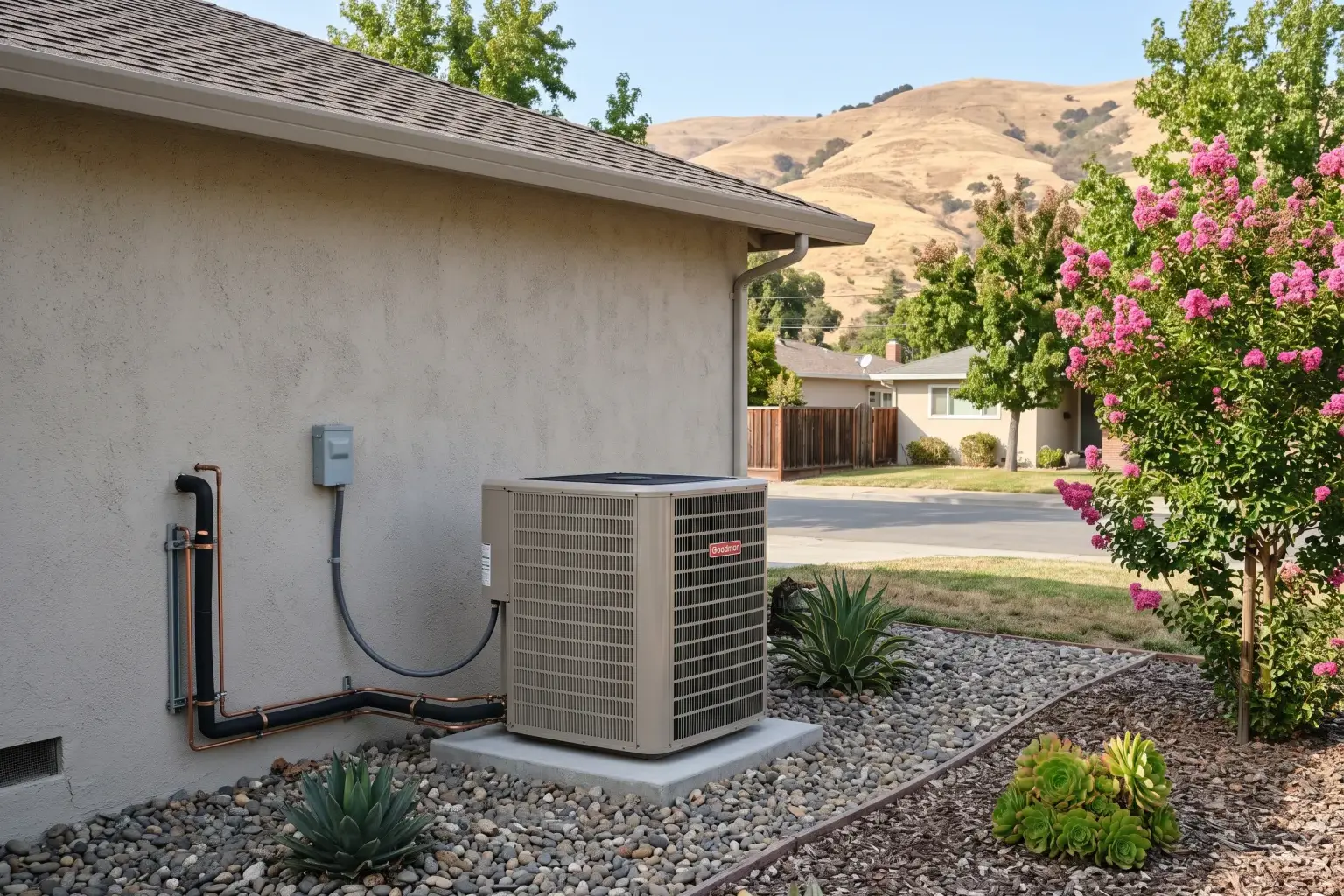
- Condition and placement of the outdoor pad, refrigerant line set, and condensate drain
- Your existing furnace or air handler, and whether it can be properly paired with a new outdoor unit
- Thermostat location, and whether zoning would help a multi-story home
Repair or Replace: Your Options
Not every struggling system needs to be replaced. If the equipment is in reasonable shape and the problem is a single part, such as a capacitor, fan motor, or a leak we can locate and fix, repair is often the sensible choice. We'll tell you when that's the case.
Replacement starts to make more sense when a major component fails on an aging system, when repairs keep stacking up, or when the system was never sized correctly to begin with. In that case, you generally have three paths:
Heat pumps are worth a serious look in the Bay Area. Under Bay Area Air District rules, natural gas furnaces manufactured from 2029 on must meet a zero-NOx emission standard, which in practice points homeowners toward heat pumps when a furnace is replaced after that date. These rules don't require you to replace working equipment; they apply only when a furnace fails or is replaced. Still, if your furnace is aging, it can make sense to plan heating and cooling together.
On incentives: the federal Energy Efficient Home Improvement Credit only covered qualifying heat pumps placed in service before December 31, 2025, so it isn't available for new installations now. BayREN and your local clean energy provider may offer heat pump or electrification incentives. Those change by funding cycle, so we confirm what's currently available before including it in a quote.
- Replace the outdoor unit and matching indoor coil, keeping a furnace that's still in good shape
- Replace the full split system, including the furnace or air handler, so every component is matched
- Install a heat pump, which cools in summer and heats in winter using a single outdoor unit
What Affects the Cost of AC Installation
Every installation is priced for the specific home, which is why we look at your system in person before quoting. The main factors are:
We'll walk you through which of these apply to your home and give you a written quote that lists the equipment and work included.
- System type: an air conditioner alone, a full split system, or a heat pump
- Capacity and efficiency: larger systems and higher-efficiency or variable-speed equipment cost more upfront
- Ductwork: whether existing ducts can be reused as-is, need sealing and repair, or need to be replaced or resized
- Electrical work: panel upgrades, new circuits, or a new disconnect
- Access: tight attics, crawlspaces, rooftop equipment, or long refrigerant line runs
- Permits and inspections required by your city
- Add-ons such as a new thermostat, zoning, or improved air filtration
How an Installation Visit Works
Here's what to expect from your first call to a finished system:
- Assessment: a technician inspects your current equipment, ductwork, and electrical, measures the home, and asks how comfortable each room is now
- Options and quote: we explain the systems that fit your home, including repair if it's realistic, and provide a written quote
- Scheduling and permits: we set an installation date and handle any permit your city requires
- Installation: the crew removes the old equipment, sets the new unit, connects refrigerant lines, electrical, and drain, and seals duct connections; straightforward replacements often take a day or two
- Startup and testing: we check refrigerant charge, airflow, supply and return temperatures, and thermostat operation
- Walkthrough: we show you how to use the thermostat, change the filter, and handle basic upkeep
- Inspection: we coordinate the city inspection to close out the permit
AC Installation by city
- AC Installation in Dublin
- AC Installation in Livermore
- AC Installation in San Ramon
- AC Installation in Union City
- AC Installation in Danville
- AC Installation in Fremont
- AC Installation in Hayward
- AC Installation in Newark
- AC Installation in San Leandro
- AC Installation in Milpitas
- AC Installation in Moraga
- AC Installation in Walnut Creek